It is far too easy in February to complain about the restrictions that the pandemic brings and to complain about cold or wet weather! The reality for me is that February has been a very good month for walks, hikes, birdwatching and enjoying nature. I am so grateful to have the opportunity to appreciate the beauty around us. Here are a few of the highlights.
Northern harrier male, with Cascade Mountains in the background.Long-eared owlMount CheamHarrison LakeSpirit Trail, Harrison Hot SpringsYellow-billed loonSumas Mountain, after fresh snowTree, cut down by a beaverSong sparrowAlder budsLicorice fern
I have been able to see snow geese on many occasions. However this weekend, I had my first opportunity get really close to a flock of snow geese; so close in fact that they were mere feet away. That gave me a very different perspective!
In the Vancouver region, virtually all of the snow geese are “white phase”. This contrasts with Kentucky where we used to live, where about half were “blue phase”. I managed to find one “blue phase snow goose” this weekend.
In the following photo taken in Kentucky, you can see that the proportion of dark or “blue phase” is large.
I always enjoy seeing snow geese in flight, particularly with Grouse Mountain as a backdrop.
I am informed that there are not generally large numbers of snow geese in the Fraser Valley. This winter has been different, and yesterday we were treated to the spectacle of thousands of snow geese lifting off, and then returning to the same field to land. It was awesome! The sight was matched by the sound of thousands of pairs of wings flapping and of the geese calling. How the geese can do this without colliding is mind-boggling!
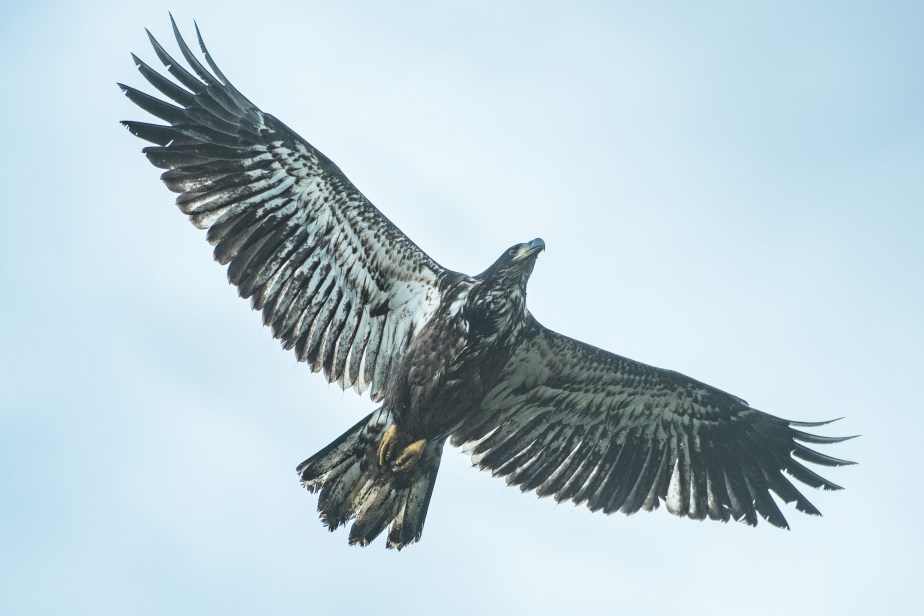
At this time of year, one of the most plentiful birds in the Fraser Valley is the bald eagle. So it is only natural that I keep taking more pictures of them. Here are a few more from the last two months.
Yesterday, the weather forecast was for reasonable weather. The forecast for the rest of the week is rain. So I decided to head out to Brunswick Point in Delta, to try to find and photograph a rough-legged hawk, which has been reported in the area. I was successful, in finding and photographing the hawk, but saw so much more than I expected to see! There were many harriers, red-tailed hawks, eagles, herons, swans, flickers, trumpeter swans and short-eared owls. The biggest surprise was that the owls were active from noon until I left at 3:00 PM. This owl is generally nocturnal, and usually the only time you can photograph them is late in the day or early in the morning, or when they are very hungry, such as after a cold spell and snow storm. Our weather has not been cold and we have not had snow recently.
Rough-legged hawk. The reason for the outing!Rough-legged hawk in flightNorthern harrier male. Sometimes called the grey ghost.Northern harrier (female or juvenile), diving for a rodent.Three harriers and a short-eared owl.Short-eared owlShort-eared owl, hiding its catch ( a small rodent)Short-eared owl, carrying a voleGiving the evil eye!Taking a closer look!A murmuration of dunlin! Fascinating to watch!
On Sunday, I drove east to the Cheam Lake Wetlands, in the Fraser Valley. I had heard that there would be a lot of trumpeter swans there, but it was important to arrive early, as they all leave within an hour or so of daybreak. I was richly rewarded for the effort. There were probably a thousand swans on the lake.
Trumpeter swans at the edge of the ice on Cheam Lake
The water was pitch black and the swans were a brilliant white. They were trumpeting at irregular intervals. Every so often there would be a vigorous flapping of wings, and splashing as groups of trumpeters would take off, literally running on the water and flapping their wings hard against the water until they achieved lift-off. This generally required close to 100 metres.
Running on the water!Lifting off!
The swans would then circle around the lake, slowly gaining altitude before disappearing into the Fraser Valley.
Flying past Bridal Veil Falls.Flying past snow on Cheam Mountain.
This was repeated over and over for about 90 minutes, with groups of anywhere from 2 to 12 lifting off at a time.
With all the rain we have been having lately, I took advantage of a break in the weather to return to the Harrison River. It was a good move as water levels have dropped and the number of eagles present was astounding!
From the moment I arrived, until the time I left, there were eagles everywhere, with the occasional eagle gliding right over me.
The river was full of spawning salmon, swimming and jumping, with many more dead salmon on the banks.
At one point in the woods, I looked up to see a dead salmon stuck in branches above me. Clearly, it had been dropped by an eagle!
On other trips, the eagles were aggressive to each other. Yesterday, when one eagle approached another, generally the standing eagle would yield its position to the new arrival. I suspect they were all very well fed, and had little desire to fight, other than to offer token resistance.
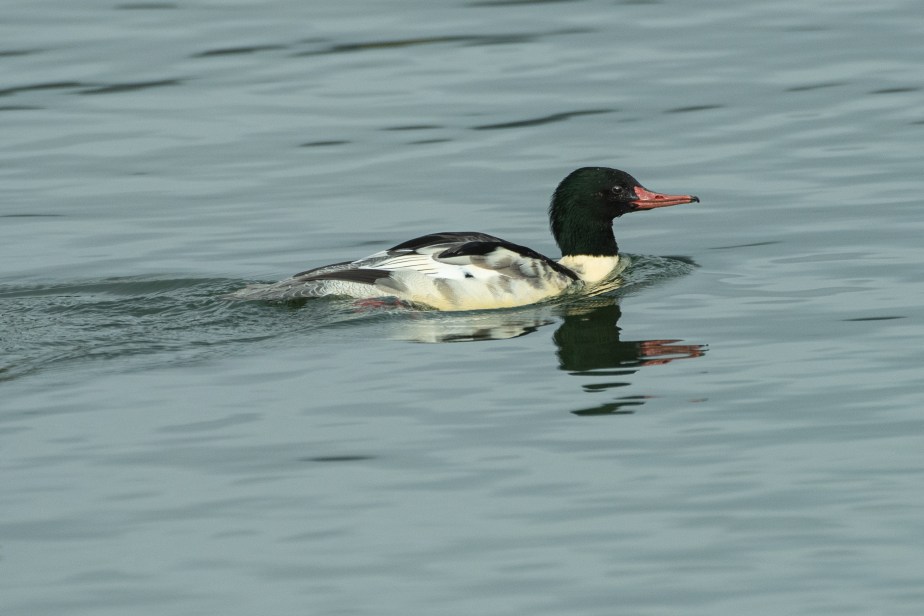
The river also had lots of ducks including goldeneye, hooded and common mergansers, mallards and American wigeon.
Just as I was preparing to go, four trumpeter swans landed in the water beside me. (There were hundreds further out in the water and the entire time I was there, I was “serenaded” by the whistling of eagles and the trumpeting of swans. What a day!
These photos were taken on the Harrison River this past Sunday. With high water, the eagles were more dispersed than they had been the week before. Still, a very enjoyable and productive outing.
The Fraser Valley, with its mild winters, open fresh water and proximity to the coast is a good wintering location for many of the birds from the north. Added to that, there are many spawning salmon in the lower Fraser in October and November. When the salmon die, they become feed for bald eagles, which flock to the rivers of the lower Fraser Valley. The following photos were taken this past week at the Nicomen Slough and the nearby Harrison River which features an exceptionally high concentration of eagles in November and December.
Mature bald eagle, Nicomen SloughJuvenile bald eagle, Harrison RiverApproximately 200 bald eagles on the eastern shore of the Harrison RiverEagle, landing on spawned out salmon, Nicomen SloughOne of 10 eagles in a tree above me, watching me! Harrison River.Mature bald eagle in flight, Nicomen SloughEagle with chum salmon, Harrison RiverEagle feeding on salmon, Nicomen SloughEagle and reflection, Nicomen SloughMallard drake, feeding on salmon. I never realized mallards would feed on fish, but I watched a pair feeding on this salmon for twenty minutes. Harrison River.Trumpeter swansFighting eagles, Nicomen Slough
Yesterday, I went to Brunswick Point in Ladner. It is a point of land , south of Vancouver, bordered by the Fraser River and the Salish Sea. I had read reports of an ash-throated flycatcher spotted there. This is normally a bird of drylands and desert and at this time of year is found in Mexico, not on the coast of British Columbia! I was lucky enough to see and photograph this misplaced bird, and managed to see another 30 species as well. It is clear that the eagles are returning to the Fraser and to the Coast now (I saw more than 20) and their numbers will peak in the winter months. I also managed to see some 2000 snow geese, which arrived in the area in the last two weeks, from their summer grounds in Siberia. It was a great outing!
I enjoy watching and photographing great blue herons. They are easy to find, easy to photograph and interesting to watch, particularly when they are fishing. The following photos were taken at the Reifel Bird Sanctuary in Delta, BC. While there were not as many there as we normally see, they were close to the trails, and that provided great opportunities to watch and photograph.
Striking for fishSuccess! This juvenile heron actually caught four fish with this strike, three of which can be seen in this photo.A better view of the four fish caught at once.The act of swallowing!